How to Teach Writing When Students Have Access to AI
Let’s talk about the elephant in the room.
You’re probably starting to notice what AI-generated writing reads like. It’s repetitive, formulaic, light on depth, and built on the same predictable patterns every time. It’s an inch deep and a mile wide, if you will.
We see it everywhere now… in emails, social media captions, ads on social media, and even in commercials. (Ew.)
AI isn’t a far-off concept anymore. It’s something our students are already encountering without even knowing they’re encountering it.
And yes, students, even the young ones, will have access to AI in education. Not just for spellcheck or brainstorming, but for producing complete assignments with a single click, if they really want to.
But we already know at this point that using AI is not leading to meaningful learning.
Not the way most people, including kids and teens, are using it now.
Research shows that when students rely too heavily on writing tools without strong foundational instruction, their critical thinking and writing skills suffer.
Before we talk about how AI changes writing instruction, let’s get honest about something, the challenge isn’t just about AI, it’s about how we’ve been teaching writing all along.
The Writing Instruction Problem We Actually Have
Many classrooms have long asked students to brainstorm, outline, and draft before ever showing them what strong writing actually looks like. This is a structural flaw in how we approach writing instruction, and writing proficiency scores show it.
Now, with easy access to AI writing tools, students can generate outlines, topic sentences, and polished paragraphs to complete assignments faster than ever. That means students can, and will, outsource every cognitive task that builds real writing skills and stamina.
The result? Even weaker foundational writing skills and no real sense of how good writing is put together.
And that’s hard to even imagine because without AI tools, writing scores are already in the tank. When 70% of our nation’s 8th graders are not proficient in writing, alarm bells are already ringing.
Introduce AI into the mix, something that can take over the very little that they’re currently doing, and we have a full blow crisis on our hands.
The solution is getting ahead of AI before students are of the age to truly explore it and redesigning writing instruction so that students internalize the thinking they’re at risk of skipping altogether.
This is exactly why Explicit Writing Instruction is so vital to changing outcomes and staying ahead of the challenges that are coming our way.
Modeling Before Writing Independence: The Case for Reverse Outlining
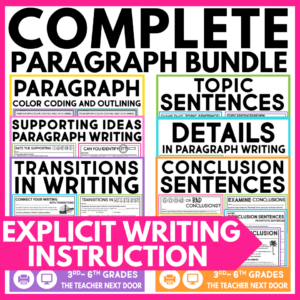
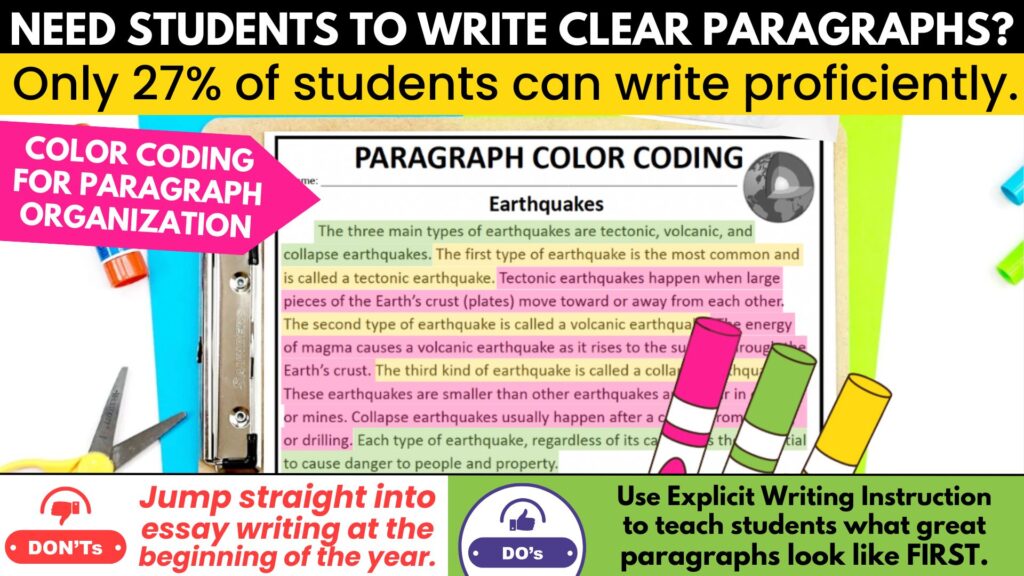
Although there are many components of Explicit Writing Instruction, let’s explore one of the most powerful shifts we can make for students. We need to consistently teach reverse outlining. This means repeatedly and systematically dissecting strong writing models before students ever try write on their own. And once they do, we continue the practice to ensure the skill of writing organization stays maintained.
Here’s how it works:
- Start with strong paragraph model.
- Together with students, not ahead of them, identify the topic sentence, supporting ideas, details, and conclusion.
- Use structured color-coding and analysis to show what quality organization looks like.
- After color-coding, add the information to a T-chart graphic organizer.
- Gradually release responsibility: model first, then practice together, then let students try independently.
These are research-supported components of Explicit Writing Instruction that lower cognitive load and give students a mental blueprint they can return to again and again.
Think of it like watching a DIY tutorial before starting a home project. We all know that jumping in without seeing the finished steps first leads to frustration fast. Writing is no different.
Yet so many curricula expect students to “just do it” with minimal models and minimal support.
Reverse outlining gives students something real to anchor their thinking to before they tackle all the complex demands of writing on their own.
Explicit Writing Instruction Works. The Research Says So.
There’s a difference between instructional trends and instructional results.
Decades of research, including work by writing scholars like Dr. Steve Graham and Dr. Karen Harris, show that Explicit Writing Instruction produces real gains in writing quality, especially for students who are already struggling.
The key components that work include:
- Sentence-level instruction
- Structured organizational support
- Modeled practice and scaffolded release
- Metacognitive reflection during and after writing
These consistently outperform approaches that rely on independent writing time alone.
Yet writing achievement in the U.S. remains stubbornly low, with only a small percentage of students reaching proficiency. That’s because many classrooms still lack strong, explicit instruction supported by intentional practice and clear models.
In a world where students have constant access to writing tools, solid writing instruction matters more than ever.
When we teach students how to think, plan, and revise, those skills become tools they can use in any situation.
Instruction Doesn’t Become “Easy” Just Because AI Exists
Some educators assume that once students reach the essay stage, they should be writing independently. That’s a misconception worth unpacking.
Even at the essay stage, students still need:
- Continued explicit instruction
- Guided feedback loops
- Practice breaking down complex writing processes
- Teacher modeling for how to organize and refine ideas
- Planning, organizing, drafting, and revision still require guided support at this stage, not just a checklist and a grade.
Writing tools can make the act of writing feel easier, but they don’t make students better thinkers. The cognitive processes need to be built and put into practice consistently. Writing is just like our bodies. We can’t workout once and expect to have strong muscles for life. We must continue the proper maintenance as time goes on. The more we do it, the stronger we get.
AI Is Here. How We Teach Students to Use It Matters.
We aren’t going to stop students from using AI tools. It’s too late for that. They’re everywhere, even appearing at the top of every Google search.
Instead, we need to teach students how to use these tools responsibly and thoughtfully, not as a shortcut but as support after foundational skills are in place.
Students who understand sentence structure, text organization, revision, and critical thinking can use these tools as a true partner for brainstorming, feedback, and refining ideas. Students who haven’t built those skills yet are far more likely to let the tool do the thinking for them, creating a false sense of mastery.
And let it be known, students should never be using AI as a tool in the elementary grades. When we say that students need to be taught how to use these tools effectively, we mean WELL after the foundation of writing skills has been built through Explicit Writing Instruction through at least grade 6.
AI has the potential to do a lot of damage to an already very fragile component of education. That’s why building grit, perseverance, and self-awareness as a writer must be at the heart of all writing instruction right now.
FAQ about AI in the Elementary Classroom
1. Should teachers ban students from using AI for writing assignments?
Not necessarily. Banning these tools doesn’t teach students how to think. Teaching them to use tools critically does. Writing tools can support brainstorming and feedback, but only after students have internalized fundamental writing skills. When we teach students to use them ethically and thoughtfully, we’re setting them up to be leaders in a world where these tools are already part of daily life. That said, all use of AI should be deterred as long as possible for all students.
2. What is reverse outlining and why is it effective?
Reverse outlining is the process of analyzing strong writing models to identify components like topic sentences, supporting ideas, details, and conclusions, and then organizing those ideas into a graphic organizer. This process lowers cognitive load and gives students a clear model and blueprint for their own writing.
3. How can writing instruction help prevent over-reliance on AI tools?
Focus should be on Explicit Writing Instruction, modeling, scaffolded practice, growth mindset, and metacognitive reflection. Writing tools should be framed as something that enhances thinking, not something that replaces it.
More Information on Explicit Writing Instruction
In this article, we only grazed the surface of the core components of Explicit Writing Instruction. To learn more about how to ensure your students are proficient writers in the age of AI, please visit our Writing Hub for additional articles and PD videos.
If you’re in need of ready to print resources that have been created and designed with Explicit Writing Instruction as a core principle, please visit TTND’s Writing Hub Resource section on TPT.
New to Explicit Writing Instruction? Start here.
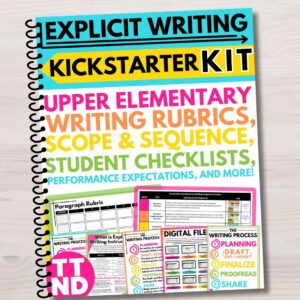
Grab TTND’s Free Explicit Writing Kickstarter Kit. This is a 98 page resource with everything you need to move toward effective, research-backed writing instruction in your classroom.