Most upper elementary classrooms share a common challenge when it comes to writing instruction: an extremely wide range of writing abilities in one classroom.
Some students can fill pages with creative stories, while others struggle to get a single sentence down. Sound like your classroom because I know it sounds like mine?
When everyone is working at such different levels, whole-group writing instruction can feel like spinning plates when you have to cram in all genres of essay writing before standardized testing.
That’s where the 10-Minute Sentence Clinic comes in. It’s short, targeted, and accessible to every student, no matter what their proficiency level.
Best of all, it actually teaches while you formatively assess and make instructional decisions.
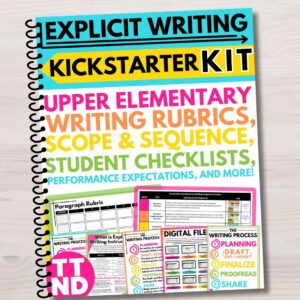
Before you implement the Sentence Clinic, you’ll want to ensure that you have access to TTND’s Free Explicit Writing Kickstarter Kit.
In the Kit, you’ll find an at-a-glance yearlong scope & sequence, writing rubrics, students-facing checklists for writing accountability, standards alignment and progression, and more.
Why Sentence-Level Writing Instruction Matters
We often ask students to dive into multi-paragraph essays before they can reliably write a complete sentence. This mismatch leads to:
- Run-on and fragment riddled writing.
- Cognitive overload when students juggle too many skills at once.
- Inequitable outcomes because struggling writers are assessed on tasks they are not yet equipped to handle because they’ve yet to receive foundational instruction that they need.
By zooming in on an individual sentence, we lower a student’s cognitive load and give them an entry point they can access, no matter their ability level.
Reluctant writers can produce one grade-level sentence while advanced writers can level up by adding complexity. Everyone grows.
This is what we call a low-floor, high–ceiling task. Everyone can complete it, but those that need to be challenged can partake at their instructional level too.
How the Clinic Works
The 10-Minute Sentence Clinic fits into any classroom schedule. It can be done whole group or small group, depending on your students and personal teaching preference.
Here’s the structure:
- I Do (Model): Choose two short, choppy sentences. Model how to combine or expand them into a stronger sentence. Think aloud as you make decisions.
- We Do (Guided Practice): Provide a similar pair and walk through it together. Read aloud to check for meaning and clarity.
- You Do (Independent): Students try one on their own. This can be as quick as jotting it on an index card
. - Quick Check: Review a few examples together. The goal isn’t grading, it’s immediate and actionable feedback.
That’s it. Ten minutes, start to finish.
Examples in Action
- Combining sentences with adjectives/adverbs
The duckling was yellow. The duckling swam in the lake. → The yellow duckling swam in the lake. - Using prepositional phrases
We saw a crow. The crow was huge. → We saw a huge crow on the fence. - Expanding with adverbs of time
The roller coaster ride came to an end. → Very quickly, the roller coaster ride came to an end.
Each example shows students how a small change can improve clarity and style, and each levels up the complexity depending on the student.
Why It Works
- Low threshold, high ceiling: Every student can complete the task, but advanced writers can push further.
- Immediate feedback: Reviewing one or two sentences whole group lets students see mistakes corrected in real time.
- Skill-building, not busywork: Instead of “extra practice,” students are explicitly taught how sentences work and they’re given immediate feedback.
- Transferable: These same moves carry into paragraph writing, where students will combine and expand ideas to build structure.
Tips for Success
- Don’t expect every student to be able to create a complex sentence (or sentences). One strong sentence is better than none.
- Always read sentences aloud. Students hear clarity (or confusion) more than they see it.
- Encourage parents to join in. Spotting strong sentences in books and recreating them verbally at home builds skill without adding fatigue.
- Keep it consistent. Ten minutes a few times a week will do more than asking kids to creatively write in a journal every day. (There’s no immediate feedback in that, and students reinforce poor writing habits this way.)
- You’ll want to grab the Free Explicit Writing Kickstarter Kit to ensure that you have access to the yearlong teaching checklists, rubrics, and year at-a-glance calendar
Free Resources
To help you implement the 10-Minute Sentence Clinic, we’ve pulled resources directly from our Comprehensive Sentence Writing Program. Inside, you’ll find:
- Anchor charts for combining and expanding sentences.
- Printable clinic pages for adjectives, adverbs, and prepositional phrases.
👉 Grab the free 10-Minute Sentence Clinic resources here
Final Thoughts
Writing proficiency doesn’t come from hoping students will “pick it up” through essays. It comes from structured, explicit practice; sentence by sentence, paragraph by paragraph, essay by essay.
The 10-Minute Sentence Clinic is one way to give every student access to success while keeping your instruction targeted and efficient. Try it this week, and see how even reluctant writers can build confidence in just ten minutes.
Frequently Asked Questions
- What is Explicit Writing Instruction (EWI) and why is it effective?
- Explicit Writing Instruction is a structured, research-backed approach where teachers model skills directly, guide students through practice, and then release responsibility for independent application. It is effective because it reduces cognitive overload, makes thinking visible, and ensures students master foundational skills like sentence writing before tackling longer essays.
- Why should I start with sentence-level instruction instead of essays?
- Starting at the sentence level helps students avoid run-ons, fragments, and confusion. It builds stamina and clarity one step at a time. Paragraphs and essays are simply sentences assembled with purpose, so when students master sentences first, higher-level writing becomes faster, more confident, and easier to assess.
- How does strong Tier 1 writing instruction reduce the need for Tier 2 or Tier 3 interventions?
- When Tier 1 instruction is clear, scaffolded, and consistent, most students reach grade-level expectations without additional support. By explicitly teaching skills like combining and expanding sentences, teachers prevent gaps from widening. Fewer students need to be pulled for Tier 2 or Tier 3 intervention, which saves time and resources while keeping more learners on track.