The Paragraph Project: Using the Science of Writing to Teach Paragraph Writing in 6 Weeks
If you teach writing to upper elementary, you already know how quickly the year fills up with essay projects, research projects, and holiday projects. October through November can feel especially packed, and yet this stretch of time is key to our students’ writing success.
Why? Because we’re at a pivotal moment in the school year. We have become acquainted with our students. We know their interests, we have an idea of where they’re at with each subject, we know who struggles with executive functioning, who needs a motivational push once (or twelve times) a day, and who needs enrichment.
We’re also in the “meat” of the school year. The habits we build now and learning that takes place will directly impact end of the year proficiency.
Sure, there’s Halloween and Thanksgiving Break, but those are a breeze to navigate compared to winter break and the doldrums of winter benchmark testing in January. (Not to mention February’s big big push to implement intervention to get kids where they need to be by standardized testing time.
This is why it’s essential to make changes to our old writing instructional methods that are yielding less than a 30% proficiency in writing for our students. (NAEP, 2011)
Writer’s Workshop and big box writing curriculums are broken.
They’re familiar and what teachers know best, but they’re consistently failing our students. If 8 out of every 30 kids in our classes are leaving us as proficient writers, who is going to catch the other 22 students up? Every. Single. Year.
The Teacher Next Door is committed to helping as many teachers as possible implement Explicit Writing Instruction.
Explicit Writing Instruction is the instructional method that aligns directly with The Science of Writing.
By now, you likely know that The Science of Reading has helped move the needle for all learners because it is grounded in science and research. Though SoR has a long way to go as we begin to conquer decoding and take on background knowledge, it has made a tremendous impact within our most vulnerable communities.
The Science of Writing is here to do the same.
Want to ensure that ALL of your students are given the opportunity to master writing?
I’m happy to introduce you to The Paragraph Project.
During The Paragraph Project, the six weeks of instruction between the first week in October and Thanksgiving Break are a singular focus: complete, well-written, grade level appropriate paragraphs.
This is the make-or-break moment for writing.
The habits and structures students internalize here will carry them into every essay, every extended response, and every piece of academic writing that follows. For years.
Without a strong foundation at the paragraph level, later writing turns into a patchwork of disconnected ideas, poorly written sentences, barely there details, and frustration on both sides of the desk. (Sound all too familiar?)
What Is The Paragraph Project?
The Paragraph Project is a six-week instructional sequence where students learn to:
- Organize their writing using a clear structure
- Craft topic sentences that set up the paragraph
- Support those ideas with details
- Use transitions to connect ideas smoothly
- Write conclusions that wrap up their thinking
In other words, it’s the bridge between sentence-level writing fluency and full essay writing.
This is the structure instructional sequencing of Explicit Writing Instruction and it is based in The Science of Writing.
The Goals and the Research That Supports Them
Why do we teach paragraphs in isolation? Because the research is clear.
Dr. Steve Graham’s and Dr. Karen Harris’s decades of writing research highlight that explicit instruction in planning, sentence construction, and paragraph organization leads to measurable gains in student writing.
Judith Hochman and Natalie Wexler have also shown that writing structure and modeling are not optional, they are what allow students to free up cognitive load and focus on clarity.
When students learn how to outline, how to recognize structure in a paragraph, and how to transfer those skills across the curriculum, they not only write better essays, their comprehension improves too.
Reading and writing proficiencies will always go hand-in-hand.
How We’re Implementing the Science of Writing at the Paragraph Level
The Paragraph Project is simple to put into practice. Using the Explicit Writing Kickstarter Kit (EWKK) as your roadmap, you’ll follow a sequence that builds week by week:
- Week 1: Pre-Assessment & Understanding Paragraph Structure and Organization Unit
- Week 2: Topic Sentences Unit
- Week 3: Supporting Ideas Unit
- Week 4: Details in Paragraphs Unit
- Week 5: Transitions in Paragraphs Unit
- Week 6: Conclusion Sentences Unit
- Final: Post-Assesment and Summative Writing Project
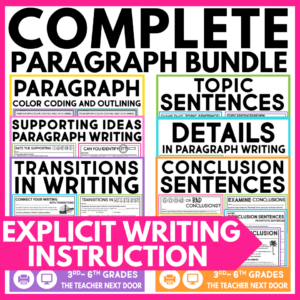
Each week’s lessons are already created for you in our Complete Paragraph Program with models, posters, and tons and tons of practice activities ready to go.
If you’ve already completed the Comprehensive Sentence Writing Program, your students will be more than ready for this leap. If not, you can use those sentence units for intervention or small group work while continuing to move forward during whole class instruction.
Why Pre and Post Assessments Matter
Before starting The Paragraph Project, have students write one independent paragraph prior to instruction. This becomes your pre-assessment. At the end of the six weeks, repeat the process for the post-assessment.
Why? Because the growth you’ll see is eye-opening.
Pre-assessments often reveal the reality: fragments, run-ons, ideas without structure,a lack of details, or cognitive overwhelm resulting in few to no sentences at all.
Post-assessments, on the other hand, show how much progress students make when given direct, scaffolded instruction.
These paired assessments are not only useful for guiding your teaching, but they are powerful for conversations with parents, co-teachers, and administrators as well.
If you’re passionate about changing writing instruction in your school, let the data speak for itself.
You can access free, editable rubrics and writing checklists within the Explicit Writing Kickstarter Kit.
The rubrics will provide you with quantitative data, while the student assessments tell the story of writing instruction done right.
Three Types of Pre/Post Prompts
Keep the playing field level by using prompts that require no prior background knowledge. Here are three you can use right away:
- Favorite Season: Write a paragraph about your favorite season and why you enjoy it.
- Favorite Place: Write a paragraph explaining a place that you love and why you enjoy it.
- Favorite Holiday: Write a paragraph explaining your favorite holiday and why you enjoy it.
These are accessible to every student, regardless of reading ability or background knowledge, and they allow you to assess organization, detail, and sentence quality without other barriers in the way.
Students should be provided with the rubric while writing their pre-assessment AND a paragraph writing checklist. Keep in mind, the pre-assessment should be administered before any paragraph-level instruction takes place.
Your students will likely struggle with the pre-assessment. That’s okay.
It’s important to let them know to do their best, and that you’ll be making sure that they know everything there is to know about writing paragraphs by the end of the unit.
A growth mindset here is key and should be foundational within all of your writing units.
The Rubric We Use
For consistency, we use the rubric from the Explicit Writing Kickstarter Kit (EWKK). It measures:
- Topic Sentences
- Supporting Ideas
- Details
- Conclusion Sentence
- Transitions
- Mechanics
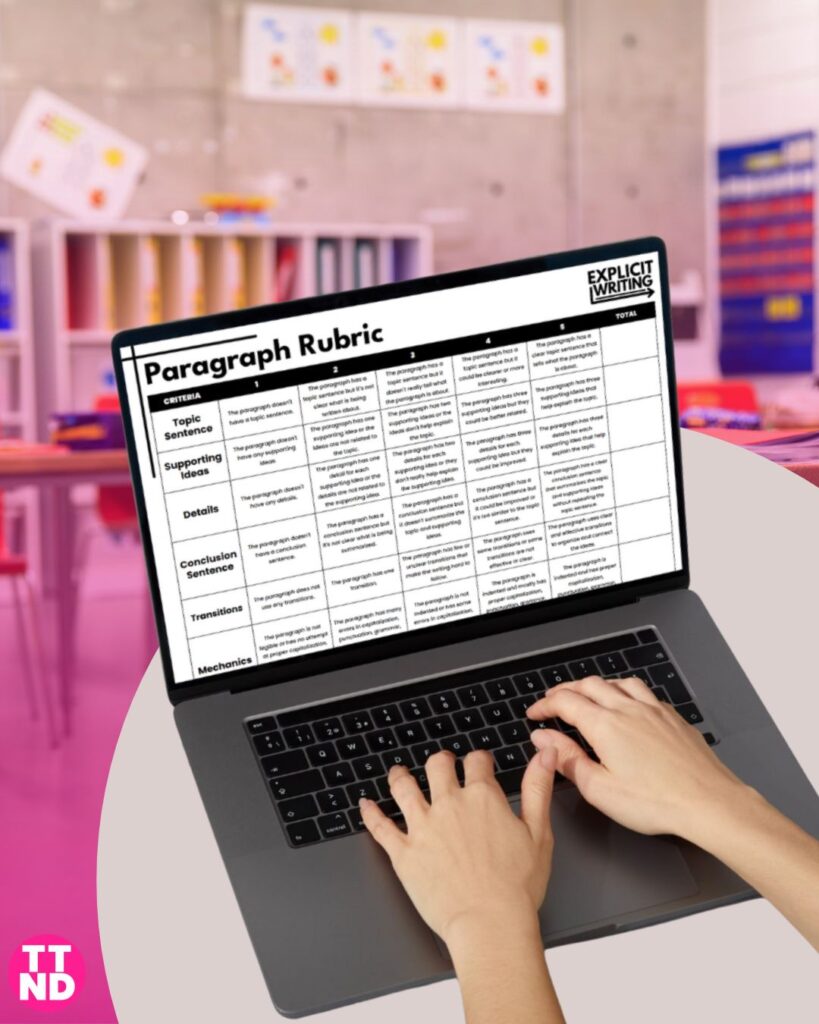
This rubric gives you a straightforward way to score pre and post samples while also providing language to share with parents about exactly where their child is and what comes next.
School-Wide Implementation
One of the biggest frustrations teachers share is trying to advocate for a better writing curriculum. When you show pre and post data, alongside rubrics and student work samples, you make the case clear: Explicit Writing Instruction works.
This isn’t just about Explicit Writing Instruction though. Paragraph skills transfer directly into social studies essays, science responses, and even math extended response items. Administrators see cross-curricular value, and co-teachers appreciate how much more manageable it becomes to support students when there’s a clear system.
What Resources We’re Using
To implement The Paragraph Project, you’ll need:
- The Explicit Writing Kickstarter Kit (EWKK) → pacing guide, rubrics, and roadmap
- The Complete Paragraph Program → detailed lessons, models, and practice activities
- The Comprehensive Sentence Writing Program → as prerequisite instruction or intervention support
With these three pieces, the work is already mapped out and classroom-ready.
As always, you are more than welcome to use our lesson plans alongside the resources you already have within your classroom or create your own resources that mirror and align with our Explicit Writing Practices.
Just know that the ready made resources are there for you if you need them.
What Comes After Paragraph Writing
The Paragraph Project isn’t the end of our writing journey. We’ve just laid the foundation for essay writing.
Once students can confidently write and organize paragraphs, we transition into essays, following the sequence in the EWKK at-a-glance:
- Informational Essays
- Opinion Essays
- Fictional Narratives
- Personal Narratives
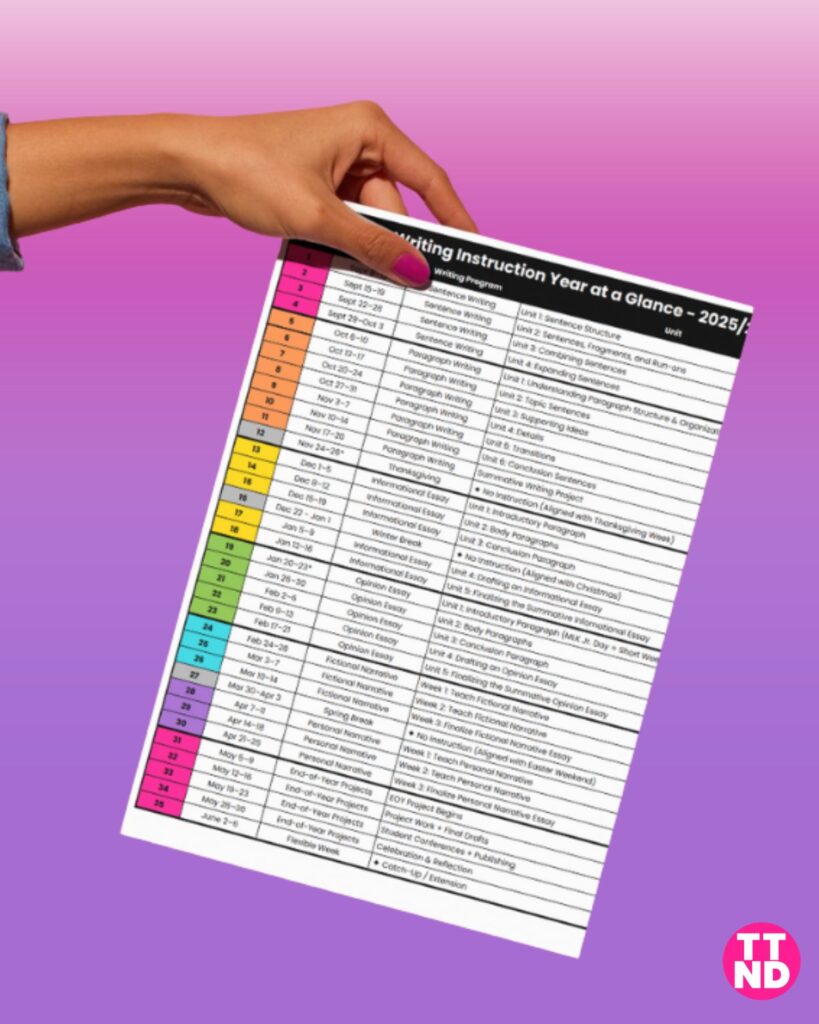
The confidence and structure built in these six weeks will carry through each essay unit, making the writing load more manageable for students and teachers alike.
Final Thoughts
The Paragraph Project is more than a writing unit. It’s the turning point of the school year, where students take on the responsibility of writing with purpose.
When we slow down to teach structure explicitly, we set students up not only for success in ELA but across every subject they encounter. That’s why over 30,000 teachers have trusted this program in their classrooms.
FAQ: The Paragraph Project
1. Who is the Paragraph Project for?
It’s designed for grades 3–5 but easily adapts for grades 6+ as remediation. It’s often used within the high school setting with students who are in significant need to writing support. The sequence aligns with Common Core standards and follows the research-based framework of Explicit Writing Instruction and The Science of Writing.
2. How much class time does it take each day?
Expect about 20–35 minutes per day. Each lesson includes an explicitly taught lesson, guided practice, and independent writing time. This structured release of responsibility fills the gaps that Writer’s Workshop leaves behind because it allows the student to gradually increase ownership of the writing process. The sequence is flexible. If a day is lost to holidays or testing, simply pick up where you left off.
3. What if I didn’t teach the Sentence Writing Program first?
You can still move forward with the Paragraph Project for whole-class instruction. Use the Comprehensive Sentence Writing Program in small groups or intervention to target fragments, run-ons, and sentence expansion while continuing paragraph-level lessons.
4. Why teach paragraphs in isolation before essays?
Research from Graham, Harris, Hochman, and Wexler shows that explicit, structured instruction builds writing fluency and reduces cognitive load. When students master paragraphs first, they write stronger essays, respond more effectively to prompts, and gain confidence across every subject area.
5. What comes after the Paragraph Project?
The skills built here lead directly into essay writing. Once students can organize and elaborate on a single idea within a paragraph, you’ll transition to informational, opinion, and narrative essays following the roadmap in the Explicit Writing Kickstarter Kit.