Let’s say you’re grading your first narrative writing assignment of the year. You stack the papers into three groups:
-
The ones that are solid
-
The ones that need a little work and support
-
The ones that are barely hanging on
You count the “solid” pile and find about eight essays, maybe nine.
Does that number sound about right? If so, you’re not alone. This pattern shows up in classrooms across the country, and national data on writing instruction backs it up.
According to the most recent NAEP writing scores, only about 27% of students are writing at a proficient level.
We have a writing crisis on our hands. And it’s not just about students not trying hard enough.
We’re Expecting Full Essays Before Teaching the Basics
Writing is one of the most demanding things we ask students to do. It pulls from every part of the brain: idea generation, organization, grammar, spelling, sentence structure, and more.
It’s the most cognitively demanding task in your entire school day.
And yet, the first thing many writing programs ask students to do after summer break is write a five-paragraph narrative essay.
No warm-up. No sentence work. Just “go.”
This shows up in almost every single big box curriculum. You know the ones that typically come bundled with your reading program and feel like writing was an afterthought? Those.
That blank page in September? It’s overwhelming. As educators, we’ve skipped all the foundational steps. It’s the academic version of handing a kid a violin and asking them to perform a sonata without ever showing them how to hold the bow or play a scale.
Most Curriculums Prioritize Craft Over Clarity
The majority of big-box writing programs, especially the ones that come with reading curriculums, lean on the Writers’ Workshop model. If you’ve been in the classroom for a few years, you’ll recognize these patterns:
-
Mini-lessons about “hooking your reader”
-
Anchor charts filled with voice and tone suggestions
-
Encouragement to brainstorm and just “write, write, write”
The problem? These programs assume students already know how to write a sentence. Or a paragraph.
They focus on craft when students haven’t even built the core writing muscles yet. These approaches are designed to help kids love writing. That’s a worthy goal—but when students don’t have the tools to succeed, it creates frustration instead.
The essay-first approach is ensuring that most students never master foundational writing skills.
We’ve Fixed Reading. Writing Is Next.
In reading, we’ve started to move away from Balanced Literacy. The Science of Reading is being implemented, and in some states, it’s becoming law. There’s more clarity now about what to teach and how to teach it.
Writing hasn’t caught up yet. (Even though it should be fully integrated across your entire ELA block—and your whole school day.)
We’re still asking kids to brainstorm, outline, draft, revise, and edit entire essays without teaching them how to do those steps. We throw in a grammar mini-lesson here or there, maybe hand out a checklist, and cross our fingers.
But hope is not a system.
The Fix: Start at the Sentence Level
We shifted our approach after studying the research from Dr. Steven Graham and Dr. Judith Hochman. We stopped starting with essays.
We begin with sentence writing. We build into paragraphs. Then we move into essays.
This isn’t slowing down instruction. It’s building a writing foundation that lasts.
A strong sentence gives students a tool they can use again and again. With stronger sentences, paragraphs become clearer. Essays become more focused.
Instead of just eight kids writing well, you start to see consistent growth across the board.
This approach works because well-written sentences are a low-floor, high-ceiling task. They’re accessible to all students and easy to scaffold upward for high achievers.
And most importantly, this structure ensures writing remains recursive. We don’t leave sentences behind once we teach paragraphs. We keep reinforcing the layers.
Writing is not a straight line. It’s a cycle of learning, revisiting, and improving. When you teach writing this way, every student can improve.
Want to Bring Explicit Writing Instruction Into Your Classroom?
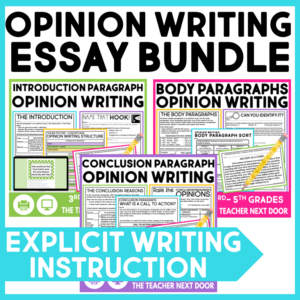
If this approach makes sense to you, we’ve built something to help you get started—without throwing out your current curriculum.

It’s called the Explicit Writing Kickstarter Kit, and it’s completely free. Inside, you’ll find:
-
A yearlong writing pacing guide
-
Editable rubrics
-
Student writing expectations
-
Printable writing process posters
-
A flexible roadmap that starts with sentences and builds toward essays
You can use it alongside your existing curriculum or as a standalone framework. It’s designed specifically for Grades 3–5 and built for real classroom constraints.
Grab the free kit here and join over 30,000 teachers working to change the way we teach writing.
Let’s make this the year more than eight students in your class write with confidence and clarity.
Helpful Links and Additional Articles:
The Upper Elementary Neighborhood Facebook Group
Explicit Writing Resources by TTND on TPT
The Writing Crisis: Why Our Students Struggle
Inside the Explicit Writing Kickstarter Kit by The Teacher Next Door