Most big-box upper elementary writing programs begin the year with narrative essays. It feels familiar. It’s how we’ve always done it. But at The Teacher Next Door, we do things differently, and this article explains why.
The Problem With Starting the Year With Narratives
Narrative writing feels like an engaging way to ease students into writing. If we let them write about their lives and interests, they’ll love writing, and if they love writing, they’ll become excellent writers.
Right? Isn’t that how it was supposed to work?
This thought process, though well-intended, is a leftover breadcrumb from Balanced Literacy and Writer’s Workshop. Repeated exposure to reading and writing in a low-stakes environment was supposed to create lifelong readers and writers.
But the results haven’t reflected this.
“Only 8 of every 30 kids are proficient in writing per the most recent NAEP scores.”
When we ask students to jump right into essays before they’ve learned how to write a clear sentence or structured paragraph, we’re setting them up to feel overwhelmed and under-supported. With so many students underperforming in writing, this signals a Tier 1 instructional issue across the nation.
Jumping straight into huge writing projects at the beginning of the year doesn’t give students time to develop strong foundational skills. Without them, they’re expected to complete one of the most cognitively demanding academic tasks—without the tools to do it well.
This instructional choice is failing our students at every level. When a high school student lacks the ability to write a well-written, complete sentence—let alone a paragraph—we haven’t done our job in giving them the tools they need to become proficient writers.
What We Teach Instead (and Why It Works)
Instead of beginning with a five-paragraph essay that demands so much from students cognitively, we start with explicit sentence writing. Yes, even in 3rd, 4th, and 5th grade.
You might be thinking, “Shouldn’t they already know how to write a sentence?”
And the answer is… technically, yes. But if you’ve taught upper elementary, you’ve seen how many students struggle to write a complete, well-structured sentence, let alone consistently and correctly capitalize.
“Sentence writing is not ‘baby work.’ It’s high-cognitive-load writing.”
By starting at the sentence level, students gain the tools they need to write with clarity, stamina, and confidence. That foundation makes more complex writing tasks manageable.
The Yearlong Writing Sequence (for Grades 3–5 and 6+ Intervention)
This model is built for 3rd, 4th, and 5th grade teachers who want a clearer path to confident, proficient student writers. However, it has also been used successfully by junior high and high school teachers who need to remediate writing instruction for students lacking foundational skills.
Here’s the sequence we follow:
Sentence Writing
Students build stamina, practice grammar in context, and develop sentence expansion and revision strategies.
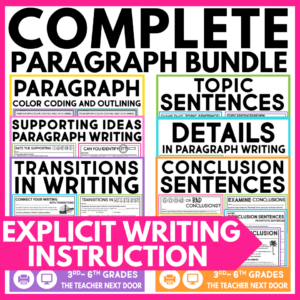
Paragraph Writing
We begin with expository paragraphs—they’re easy to scaffold, easy to connect to content areas, and easy for kids to grasp. These paragraphs follow a step-by-step organizational process and utilize tons of exemplars so that students can repeatedly see, dissect, analyze, and recreate successful paragraph structure.
Informational Essay Writing
Building from one paragraph to five, students learn to elaborate on ideas while staying organized and clear. Moving into this type of essay first allows us to bridge the exact same successful Explicit Writing Instruction found within paragraph and sentence writing.
And when we begin essays, we don’t leave sentence and paragraph instruction behind. The structure is sequential by design, helping students build from small sentences to full essays.
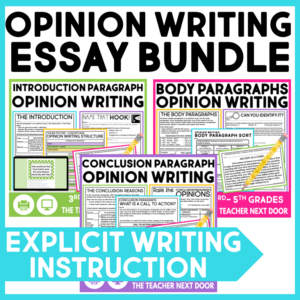
Opinion Essay Writing
Once essay structure is in place, students inject voice and argument into opinion essays while sticking to the same strong organizational practices they’ve practiced all year.
Narrative Writing (Fictional + Personal)
We save this for the end of the year, on purpose. As we approach standardized testing season, we shift into narrative writing.
Narratives are fun, creative, and high-interest, but only when students have the tools to write them well. They’re almost always found on state assessments too, so this is a great time to review story elements, writing craft, and structure.
Want to See Our Writing Instructional Plan in Action?
If you’re ready to rethink your writing instruction sequence, we’ve got a free resource to help you do it right.
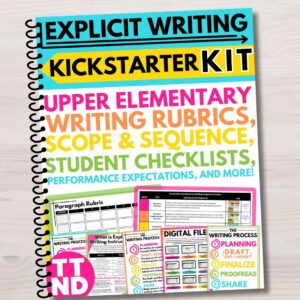
The Explicit Writing Kickstarter Kit includes:
- A year-at-a-glance pacing guide for the entire school year
- Rubrics and checklists aligned to each stage of instruction
- Lesson breakdowns for each and every unit
- Editable Google Slides and templates for classroom use
- A breakdown of how to gradually release responsibility across units
Ready to teach writing with purpose and clarity?
A Simpler, Smarter Sequence for Real Writing Growth
We’re taking the best parts of what we know works in writing instruction, restructuring them, and putting them in a sequential order that makes sense for students.
No gimmicks. No fluff. Just a clearer path to confident, proficient writers.
You don’t have to start the year with essays.
Start with what builds real writing skills, one strong sentence at a time.