You’re sitting at your desk in October following your Big Box Writing Curriculum’s Scope and Sequence and working through a stack of fourth-grade writing assessments when you start sorting them into piles. There’s a pile of strong ones. A pile for the middle of the road ones. And a pretty hefty pile of ones that either contain little to no writing at all or need major, major work.
If you’ve been teaching upper elementary for any length of time, you know that pile, and you’ve probably wondered the same thing I used to wonder: why isn’t what I’m doing working for these students?
Here’s the part nobody told us in college, it’s almost never about the lessons themselves, it’s about the entire instructional design of our writing programs.
If you’ve been searching for a writing scope and sequence for upper elementary, the answer is shorter, albeit a lot more unusual than you’d think – especially for upper elementary. We need to start with sentences, not paragraphs, not essays, not writing prompts. Sentences. Let’s talk about why Explicit Writing Instruction and starting at the sentence level makes a difference in third, fourth, and fifth grade.
Why the Order of Writing Instruction Matters
The order you teach writing determines whether students build true foundational skills or accumulate skill gaps.
When our scope and sequence isn’t based on how a child’s brain develops, students are asked to complete complex tasks before they have the foundational skills to support them.
This is when we end up with incomplete sentences, weak organization, and writing that sits well below grade level no matter how much time you spend on it.
For decades, most upper elementary classrooms followed roughly the same pattern. Start the year with personal narratives because they’re fun and accessible, and of course they’re promised to ensure our students learn to love writing time.
After all, it makes sense, right? Narratives are typically paired with our fiction unit in ELA, why not teach plot diagrams while writing a narrative that lends its hand to plot diagram planning too?
Not to mention, we’ll lean on a Writer’s Workshop with short mini-lessons and lots of independent writing time too. That way our students will picture themselves as authors. (I hope you can tell I’m being a bit facetious here.)
The promise was that if students started with a writing unit that was deemed “enjoyable,” they’d learn to love writing, and the more they wrote, the better they’d get.
For a handful of students every year, that promise was kept. For the rest, it left them with major gaps in their writing abilities.
National writing scores tell the story plainly. According to the most recent National Assessment of Educational Progress (NAEP) writing data, only about 27% of U.S. eighth graders score at or above proficient. That number has barely moved in decades.
This isn’t a teacher problem. Teachers were have been given an instructional model and told it would work for decades.
The model is what failed. Just as balanced literacy was intended to create proficient, well-rounded readers and failed, Writer’s Workshop has also failed our nation’s students.
The good news is that we know what works instead, and we know in what order to teach it.
The Shift to Explicit Writing Instruction
Explicit Writing Instruction is a structured, research-based approach that teaches writing skills directly and in a clear sequence, building from simple to complex.
Instead of trying to convince students to love the craft of writing (by making them write and write and write some more) and hoping the skills develop through exposure, Explicit Writing Instruction teaches each skill on its own, models it, practices it, and then layers it into more complex tasks.
The approach is grounded in research from Dr. Steve Graham, Dr. Karen Harris, and the Carnegie Corporation’s Writing Next report, which identifies explicit, structured writing instruction as one of the most effective levers for improving student writing outcomes.
The reason it works comes down to helping a student manage the cognitive load successfully.
Writing is the most cognitively demanding task in your entire school day. Students have to juggle ideas, sentence structure, spelling, punctuation, organization, and revision all at once. When foundational skills like sentence construction haven’t been solidified into long-term memory and can’t be retrieved automatically, every one of those elements competes for working memory space at the same time.
When foundational skills are taught explicitly and practiced until they become automatic, cognitive load becomes manageable. Students stop spending working memory on whether their sentence has a subject, and they can finally spend it on what they want to say.
The Writing Scope and Sequence That Actually Works
Here is the sequence that produces consistent results in grades 3 through 5:
- Sentence writing (about four weeks, August through September)
- Paragraph writing (six to seven weeks, October into November)
- Informational essays (December into January)
- Opinion essays (late January through February)
- Narrative writing, fictional and personal (March through April)

Each step builds directly on the one before it. Nothing skips ahead. Nothing assumes a skill students don’t yet have.
Step 1: Start with Sentence Writing
We begin the year by spending roughly four weeks on sentences. Yes, just sentences. This covers complete sentences (subject and predicate), fragments and run-ons, sentence combining, and sentence expansion with structures like appositives.
Most upper elementary writing programs assume students already have these skills, but data shows that most upper elementary students don’t.
Even in the spring, plenty of fourth and fifth graders still can’t reliably write a complete sentence with correct capitalization and end punctuation. When we skip past this step in September, we spend the rest of the year trying to reteach it (or remind students of it) during small groups and one-on-one conferences. But those small group lessons never quite catch everyone up, do they?
Front-loading sentence work does two things at once. It closes foundational gaps before they compound, and it establishes the instructional routine you’ll use all year: I do, we do, you do.
None of this is groundbreaking, nor is it brand new. However, the consistency and structure is what makes it work.
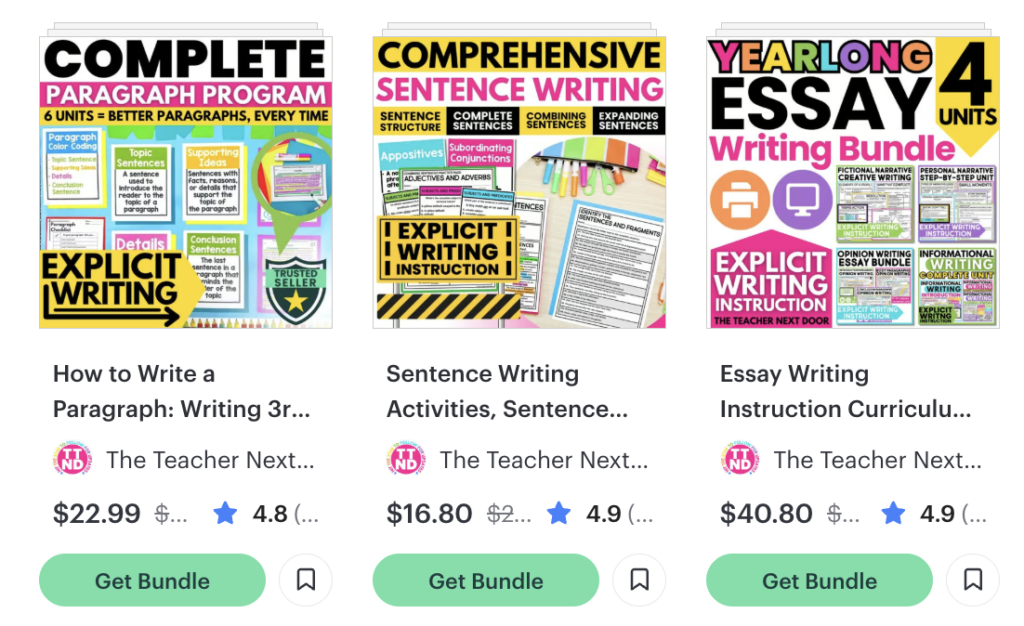
- Find TTND’s Complete Sentence Writing Program here.
Step 2: Move to Paragraph Writing
Once students can reliably write strong sentences, we move to paragraphs. This is where structure becomes visible. Students learn topic sentences, supporting ideas, details, transitions, and conclusion sentences, and each component is taught and practiced in isolation before they’re asked to write a full paragraph.
Most writing breakdowns in upper elementary happen at the paragraph level. Students don’t usually struggle with ideas. They struggle with organizing those ideas into a clear structure. Strong paragraph instruction is what fixes that, and it’s also what makes everything that comes next possible.
Think of it like learning to cook from a recipe before you can improvise a meal. You need a really good model first, and you need to come back to that model more than once. Students need the same thing. They need to see what a well-built paragraph looks like, sounds like, and feels like before they can build one of their own.
- Find TTND’s Complete Paragraph Program here.
Want to see this entire sequence mapped out for your school year?
The Explicit Writing Kickstarter Kit is a free 98-page resource that includes a yearlong writing pacing guide, editable rubrics, student writing expectations, and a step-by-step scope and sequence from sentences through essays.
Over 30,000 teachers are using it to restructure their writing instruction.
Step 3: Transition to Informational Essays
Once students understand how to build a paragraph, we expand that same structure into essays.
An informational essay is simply multiple (paragraphs working together: an introduction paragraph, body paragraphs, and a conclusion paragraph. Each part gets taught separately, in its own week, before students draft a full essay.
This is what keeps cognitive load manageable through the transition to lengthier writing. We’re not asking students to write an essay off the bat, we’re asking them to write an introduction paragraph, which they already know how to do because they spent six weeks learning about how to write well-written, grade level appropriate paragraphs. Plus, we deliver the new format of the introductory paragraph the same way we taught paragraphs prior to this, with models, practice, and gradual release. The next week, we write body paragraphs, and thee next week, the conclusion paragraph. Finally, we put the pieces together and hand the task of writing an essay, the summative assessment, independently with the skills they’ve now had added to their writing toolboxes.
- Find TTND’s Informational Essay Unit here.
Step 4: Add Opinion Writing
Opinion writing instruction follows the same structural pattern as informational writing, in fact, it’s almost identical. The thing that changes is the genre and how the writing is organized due to the nature of needing to defend a stance. Students develop a claim, support it with reasoning, and strengthen their argument with evidence.
Because the instructional delivery is already familiar, students can now use their working memory on the higher-level thinking instead of on basic organization and having to guess what “done” looks like.
- Find TTND’s Opinion Writing Program here.
Step 5: End with Narrative Writing
Narrative writing comes last. (We know, we know… this is weird.) This is the part that surprises most teachers because narrative is what we’ve pretty much always opened the school year with.
When narratives come at the beginning of the year, we tend to get two kinds of writing back. The first kind is too much: run-on sentences, ideas spilling in every direction, unnecessary detail, and no real shape.
The second kind is too little: two sentences, then “I’m done,” from the reluctant writers who don’t know where to start.
Neither one is a creativity problem; both are structure and what we like to call “Swiss cheese” learning problems.
Swiss cheese learning problems arise from the gaps and holes in learning making the final task near impossibly to complete proficiently because only some of the skills needed to complete the job are present.
When narratives come at the end of the year, students already have sentence fluency, paragraph structure, organizational skills, and writing stamina.
Now, students can focus on storytelling without being buried by mechanics. The writing you get back in March and April looks nothing like the writing you used to get in September.
Plus, this means we can effectively teach writing craft to our students once the foundation has been set.
- Find TTND’s Fictional and Personal Narrative Writing Unit here.
Why This Scope and Sequence Improves Writing Outcomes
This instructional sequence works because it matches how learning actually happens in the brain.
It builds automaticity at the sentence level, keeps cognitive load manageable through predictable structure, supports the executive functioning that nine and ten year olds are still developing, and creates consistent expectations across the entire year.
When students don’t have to think about how to write a sentence, they can finally think about what they want to say. That single shift changes everything about the writing you see come back from your class.
Compare it to a kid learning basketball. If they can’t dribble, can’t make a free throw, and pick up a foul every time they touch the ball, they’re not going to fall in love with the sport. They’ll quit, they’ll whine, they’ll stomp off the court. Writing works the same way. Students only fall in love with writing once they’re successful at it, not before. Anyone who tells you differently is likely ignoring the elephant in the room, the 27% writing proficiency rates of our nation’s eighth graders.
How to Implement This Without Rebuilding Your Entire Year
We have two paths from here.
The first path is to take this sequence and build the materials yourself. You’ll need grade-level writing exemplars for every component skill (and you’ll need a lot of them, because students need to revisit good models repeatedly).
You’re also going to need a handful of structured practice activities for each skill that move through the gradual release model.
And last, you’ll need scaffolds for small group instruction and rubrics that align to each specific skill you’re teaching in each unit.
The second path is to use a sequence that already has those pieces built. TTND’s writing units are designed around this exact progression, and each unit includes:
- Dozens of grade-level exemplar paragraphs sequenced to match each component lesson, so students always have a model to emulate at the moment they need it
- Whole group, small group, and independent practice activities built into a gradual release structure
- Scaffolding cards and graphic organizers for differentiating with students who need more support
- Rubrics that align to every specific skill taught in each unit, not generic writing rubrics
You’ll need every one of those pieces to implement this approach the way it’s designed. Both paths get you to the same destination, the second one just saves you the year it takes to build it from scratch.
Final Thought
If writing instruction has felt harder than it should, it’s not because you’re doing something wrong, it’s because the systematic way we’ve been teaching writing for decades has yielded subpar results.
TTND is committed to fixing the writing problem in our nations’ schools.
Join us by starting with sentences, building to paragraphs, and then scaling to essays. Teach students how to handle the huge cognitive load that comes with writing and gradually release writing responsibility over to them.
It’ll make all the difference.
FAQ: Writing Scope and Sequence for Upper Elementary
What order should I teach writing in upper elementary?
The most effective order is sentence writing, paragraph writing, informational essays, opinion essays, and narrative writing last. This sequence builds skills from simple to complex and keeps cognitive load manageable so students can focus on what they’re saying instead of how to construct a sentence.
Why shouldn’t I start the year with narrative writing?
Narrative writing requires strong sentence structure, paragraph organization, and writing stamina. When students don’t have those skills yet, narratives become unfocused or fall apart entirely. Teaching narratives at the end of the year lets students apply skills they’ve already built, and the writing you get back is dramatically stronger.
How long should I spend on sentence writing at the start of the year?
About four weeks. That investment in September prevents months of reteaching later in the year, and it builds the foundation every other writing unit depends on.
What is Explicit Writing Instruction?
Explicit Writing Instruction is a structured approach where each writing skill is taught directly, modeled clearly, and practiced through a gradual release process before being layered into more complex writing tasks. It’s grounded in research from Dr. Steve Graham, Dr. Karen Harris, and the Carnegie Corporation’s Writing Next report.
Can this sequence work for older students or students with significant gaps?
Yes. The sequence is effective for any student missing foundational writing skills, including middle school and high school students. Because it rebuilds the writing process from sentences up, it closes gaps that other approaches tend to leave in place.
What if I only have 30 minutes a day for writing instruction?
The sequence still works. Each unit uses the gradual release model which contain short, focused lessons.. This means that a 30-minute block is enough time to teach a mini-lesson, practice together, and give students independent work time. The key is protecting the time and keeping the routine consistent.